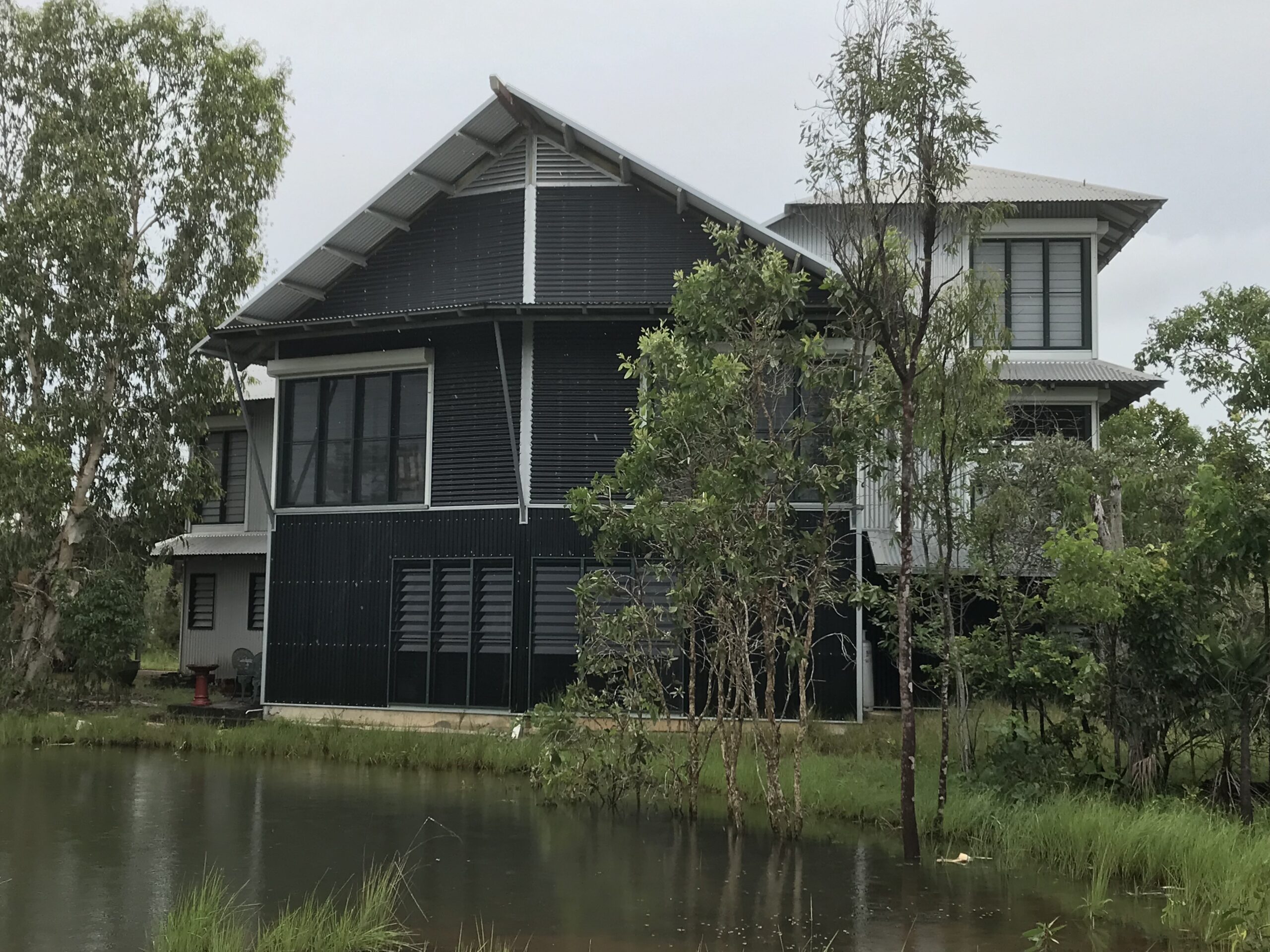

Wavertree House

Darwin River,
NT
Online home tour

About this home

Wavertree House is a steel-framed, zincalume-clad, three-storey residence designed for the wet-dry tropics.

Its passive cooling characteristics are drawn from the design principles of the Burnett designed houses of the late 1930s in Darwin.

These emphasise high reflectivity, natural airflow, breeze orientation in order to achieve passive cooling. It is solar powered and off-grid, and designed to prevent ember attack from wildfires, termite attack and to resist earth tremor shock.

The house is located on an 80 hectare Land for Wildlife private reserve of native riparian, swamp and open savannah woodland.
Q & A

What motivated you to build or retrofit sustainably?
We wanted to be able to live on our Land for Wildlife block in the most environmentally benign house that we could afford, given available technologies. We wanted to be off-grid for reliability and minimal environmental impact. We have had to retrofit elements when the materials or appliances originally specified did not perform to expectations.
The retrofitting of glass and aluminium window louvres when roller shutters were found to be cyclone code non-compliant increased the safety and day-to-day weather control flexibility of the house considerably and enhanced the potentialities of the original passive cooling design.
We wish we had known that the roller shutters on the window spaces were non-compliant with cyclone codes (contrary to their advertising). We wish we had known that the Biolytix worm farm sewage treatment system had an inherent design fault that would cause it to fail. Both these issues have caused unnecessary expense that would have been avoided if better information had been available at the time of the initial design.
We would reinstate above-window shade awnings on the ground floor external walls that we allowed the builder to talk us out of. Similarly, we would replace first floor lazerlite panels that have corrugations mounted horizontally with vertically mounted ones as we originally specified. Horizontal corrugations collect dirt and become opaque over time, compared to vertically mounted ones. When you have specified a design element for good reason, do not let the builder talk you into a lesser outcome for his own convenience.
Type: Standalone house/townhouse
Project: Gradual upgrades over time
Architect: Andrew Spiers and David Bridgman
Designer: Andrew Spiers
Builder: Garrett Homes
Size: 232m2 approxm²
Energy Rating: 8.3
Bedrooms: 2
Bathrooms: 2

Sustainability Features

Building Materials & Envelope

High-performance insulation
Sustainable or low-impact materials
Other

Heating, Cooling and Ventilation

Passive heating/cooling (north-facing glazing, cross ventilation, thermal mass, shading, etc.)
Ceiling fans

Energy and Appliances

Rooftop solar PV
Battery storage
Efficient lighting (LED, daylighting, solar skylights)
Solar thermal hot water

Water & Waste Systems

Water-efficient fixtures
Rainwater tanks

Landscape & Biodiversity

Edible garden
Wildlife-supporting habitat

Climate Resilience

Flood
Bushfire
Cyclone/storm
Heatwave

Accessible & Flexible Design Features

Universal design for accessibility
Share this home:

Related Homes

Home tours delivered to your inbox

Step inside sustainable homes across Australia and get practical ideas you can use in your own